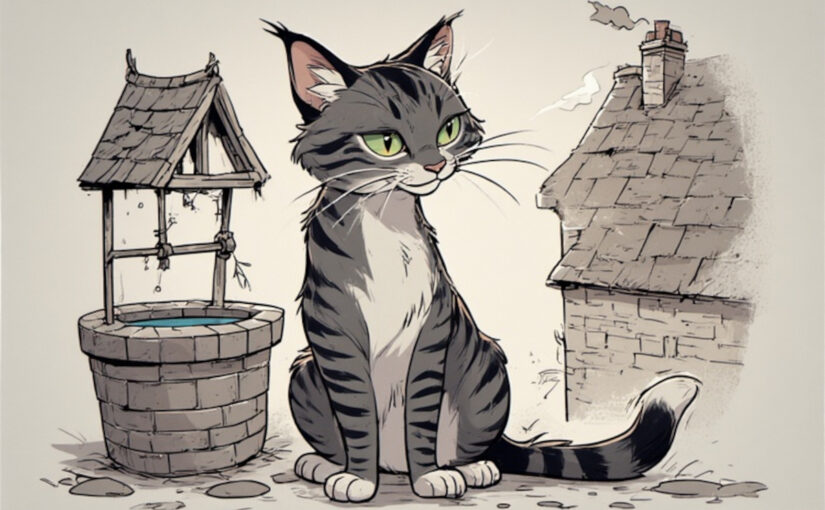
Spieglein is not your average kitten; he is a feline philosopher whose adventures lead straight into the heart of an old Swiss town full of magic, mischief, and very human folly. This newly translated classic tale is perfect for anyone who loves cats with personality, wit, and just a hint of danger.
The story begins in Seldwyla, a small Swiss city tucked between green mountains, where people are poor, lazy, and oddly content, and where “nothing is supposed to happen” – so of course everything does. Into this cozy but eccentric world steps Spieglein, a grey‑black kitten with a gleaming coat, sharp mind, and a very clear sense of what (and who) he finds acceptable.
Spieglein hunts mice with style, tolerates kind teasing, and refuses to waste his claws on fools – at least until fate strikes and he loses his beloved elderly mistress. Watching this proud, clever cat struggle with grief, hunger, and the temptation to give up his dignity is one of the story’s most touching threads.
When the town sorcerer Herr Pineiss appears, offering food and comfort in exchange for “future cat lard,” the tale suddenly turns darkly comic and strangely modern. What follows is a battle of wits between a power‑hungry human and a cat who slowly rediscovers his self‑respect.
Readers who love fairy tales, folk magic, and slightly spooky atmosphere will enjoy Herr Pineiss’s crammed, labyrinthine house, his bizarre side jobs, and his not‑quite-ethical sorcery. Spieglein roams the roofs, watches spells being cast, and eventually learns to turn both passion and prudence to his advantage.
There is romance (in the form of wild rooftop cat love), a treasure hidden in a well, a terrifying “pious” neighbor who is more witch than saint, and a final twist that explains why, in Seldwyla, people say “He bought the lard from the cat!” when someone marries badly.
If you have ever looked at your cat and thought, “You understand more than you’re letting on,” this story will feel like a secret confirmation. Spieglein’s moods, his pride, his sudden bursts of wildness and long stretches of contemplation are written exactly as many cat owners experience their companions every day.
“Spieglein, the Kitten” is both a charming cat fable and a sharp little satire on greed, contracts, and human self‑deception – all seen through the clear, amused eyes of a cat. Curl up with your own feline, open the story, and let Spieglein lead you across the rooftops of Seldwyla into a world where a kitten can outsmart a sorcerer and change a proverb forever.
Editorial Note:
Spieglein, the Kitten
(Original: Spiegel, das Kätzchen, by Gottfried Keller (1819–1890), first published in Die Leute von Seldwyla, Braunschweig, Vieweg, 1856.)
Translated from the German using a large language model, 2025.
The original work and the translation are in the public domain worldwide.
Text, formatting, and editorial arrangement are released into the public domain under the CC0 1.0 Universal Public Domain Dedication (https://creativecommons.org/publicdomain/zero/1.0/).
You may copy, modify, distribute, and use this work, including for commercial purposes, without permission.
Published by Steffen Blaese, Berlin, Germany, 2025.