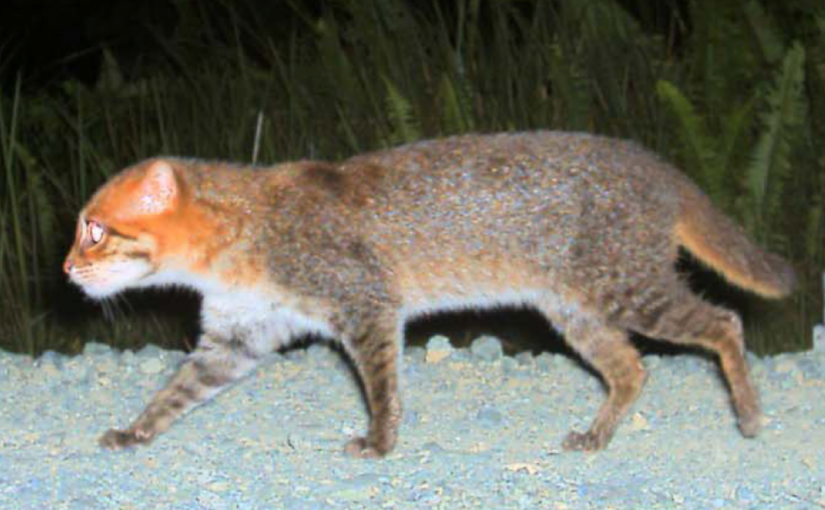
A camera trap deep in southern Thailand has captured something remarkable. A small, nocturnal wildcat with distinctive flattened features stares into the lens, proof that a species written off as locally extinct still prowls the region’s vanishing wetlands. The flat-headed cat, unseen in Thailand since 1995, has reappeared in the Princess Sirindhorn Wildlife Sanctuary, offering both jubilation and urgent concern for conservationists.
The discovery comes from a collaborative survey between Thailand’s Department of National Parks, Wildlife and Plant Conservation and Panthera, the global wildcat conservation organization. Between 2024 and 2025, their camera traps recorded 29 separate captures of these elusive felines, including footage of a female with her kitten. For researchers who had long classified the species as “possibly extinct” in Thailand, the images represent an extraordinary moment. The last confirmed sighting here dated back to 1995, leading experts to label the species as possibly extinct in the country.
Smaller than a typical house cat, the flat-headed cat, or Prionailurus planiceps, thrives in Southeast Asia’s vanishing wetlands. Its flattened head and short snout suit a diet heavy on fish, crabs, and frogs, while partially webbed paws propel it through swamps and mangroves with ease. Nocturnal and solitary, it shuns open areas, making field studies a nightmare amid tangled rainforests. The IUCN Red List pegs the wild population at around 2,500 mature individuals, classifying it as Endangered across Brunei, Indonesia, Malaysia, and Thailand.
Further Reading: The Flat-Headed Cat: The Little Fisher of the Swamps
These densely vegetated ecosystems pose significant challenges for traditional field research, according to Rattapan Pattanarangsan, who leads Panthera’s conservation program in the region. Camera traps provide the only practical method for monitoring animals that move silently through tangled undergrowth after dark. Yet even with photographic evidence, researchers face difficulties determining exact population numbers. Individual flat-headed cats look remarkably similar, making it nearly impossible to distinguish between repeated captures of the same animal versus sightings of different individuals.
Joy over the rediscovery mixes with deep alarm. The same forces that nearly eliminated flat-headed cats from Thailand continue unabated. Thailand’s swamp forests, prime habitat for these cats, shrink under agricultural expansion, palm oil plantations fragmenting the landscape into isolated patches. Reproduction suffers in such splintered territories. Disease transmission from domestic animals compounds the habitat crisis. Village cats and dogs carry pathogens that can devastate wildcat populations with no prior exposure or immunity. As human settlements push deeper into remaining forest areas, contact between domestic and wild species increases, creating new pathways for infectious diseases to jump between populations.
Without dedicated protection for remaining wetland habitats, enforcement against further agricultural encroachment, and buffer zones to minimize disease transmission from domestic animals, this remarkable comeback story could end in final extinction within decades. The research team plans to petition the IUCN for an updated status on Thailand’s flat-headed cats, potentially unlocking targeted protections.
IUCN Red List of Threatened Species – Flat-Headed Cat Assessment
https://www.iucnredlist.org/species/18148/50662095
The International Union for Conservation of Nature maintains the authoritative global assessment of the flat-headed cat’s conservation status. This detailed report, last updated in 2015, classifies the species as Endangered and documents its restricted distribution, population estimates, and primary threats including wetland destruction and habitat degradation.
Panthera – Global Wild Cat Conservation Organization
https://www.panthera.org
Panthera conducts cutting-edge scientific research on all 40 wild cat species worldwide and led the camera trap survey that rediscovered the flat-headed cat in Thailand. Their conservation programs combine field science, habitat restoration, and community partnerships to protect endangered felids.
Thailand Department of National Parks, Wildlife and Plant Conservation (DNP)
https://www.dnp.go.th
Thailand’s official wildlife authority jointly announced the flat-headed cat rediscovery on December 26, 2025, with DNP Director-General Attapol Charoenchansa confirming 29 camera trap records across 2024 and 2025 in the Princess Sirindhorn Wildlife Sanctuary. The DNP oversees protection efforts for Thailand’s remaining peat swamp habitats critical to the species’ survival.
Image: Andreas Wilting et al.